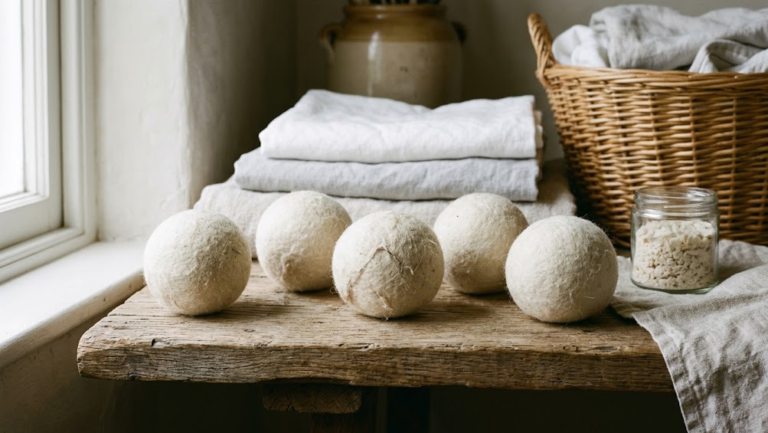
Most people who switch to wool dryer balls do it because dryer sheets feel vaguely chemical and wool feels natural. That instinct is pointing at something real, but it understates the actual mechanism. Dryer sheets do not just add fragrance. They coat your clothes with a waxy film by design, and that film is still on the fabric when you put it on. Understanding that changes what the comparison is actually about.
This piece covers the wool dryer balls vs dryer sheets question directly: what each product physically does, where wool balls fall short honestly, and what the chemistry in a conventional dryer sheet actually is.
Some links in this article are affiliate links. No brand paid to be included.
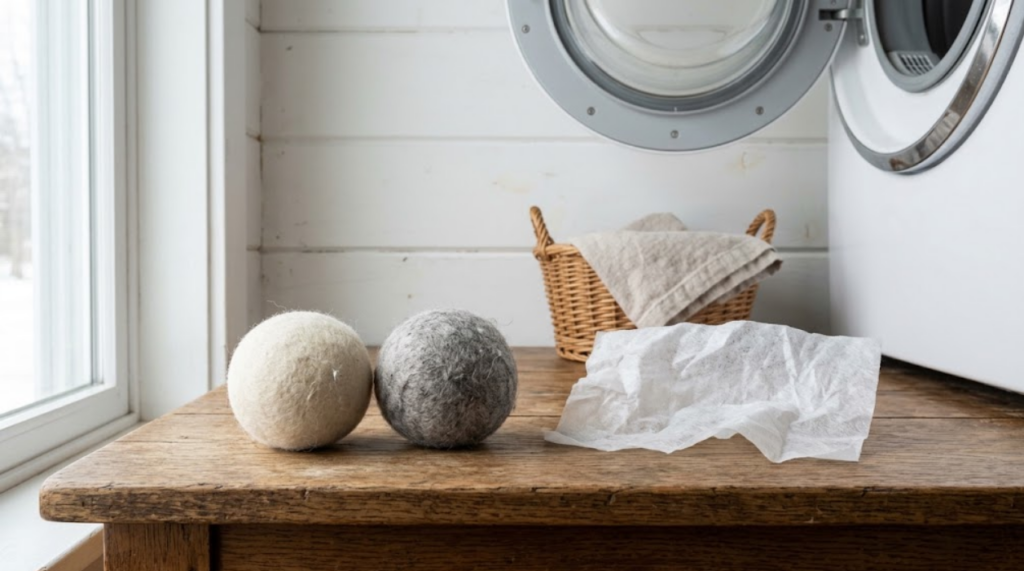
Wool Dryer Balls vs Dryer Sheets: Quick Comparison
| Wool Dryer Balls | Dryer Sheets | |
|---|---|---|
| How it works | Mechanical agitation + moisture release | Chemical coating deposited on fabric |
| Softening mechanism | Separates and fluffs fibers physically | Quaternary ammonium compound residue on fibers |
| Static reduction | Indirect, via humidity increase | Direct positive-ion discharge; more effective |
| Drying time | Claims up to 30% reduction; independent tests show ~13% for tumble balls | No effect |
| Per-load cost | Under $0.10 after initial outlay | $0.10–$0.25 per sheet |
| Fragrance chemicals | None, unless you add essential oils | Multiple fragrance compounds, including VOCs |
| Reusability | 1,000+ loads | Single use |
What Dryer Sheets Actually Do to Your Clothes
The softness a dryer sheet produces is not a temporary effect that washes off. It is a waxy film deposited onto fabric fibers by design. As the sheet heats up in the drum, it releases a mixture of fatty acid compounds, quaternary ammonium salts, and fragrance chemicals that coat every surface they contact. The fabric feels softer because it has been physically coated with something slippery.
Church & Dwight, which makes Arm & Hammer dryer sheets, lists the active softening agent as a quaternary ammonium salt sourced from Stepan Company under a trade-secret formulation. Church & Dwight does not publicly disclose the identity of the specific compound. What the safety data sheet does disclose is the fragrance package, which includes hexamethylindanopyran, a synthetic musk that appears on the EPA’s list of persistent, bioaccumulative, and toxic (PBT) chemical candidates.
That coating is still present on the fabric after the cycle ends and carries through into the next wear. For people with fragrance sensitivities or skin conditions, this is not a theoretical concern.
The emissions piece is separate. A 2011 University of Washington study led by environmental engineer Anne Steinemann tested dryer vent emissions from a leading scented dryer sheet and found more than 25 volatile organic compounds, including seven classified as hazardous air pollutants. Acetaldehyde and benzene were both detected. The EPA classifies both as carcinogens with no established safe exposure level. The researchers estimated that one dryer using scented products could account for roughly 3% of total automobile-sourced acetaldehyde emissions in Seattle.
That is the vent. The fabric coating and the vent emissions are two separate things the same sheet produces.
What Wool Dryer Balls Actually Do
Wool dryer balls work through two physical mechanisms, not chemistry.
First, they tumble among the clothes and separate fabric items from each other. Clumped laundry dries unevenly; separation exposes more surface area to hot airflow, which is why drying time drops with balls in the drum.
Second, wool absorbs moisture from the humid drum air during the drying cycle and releases it gradually. This keeps the air inside the drum slightly more humid than it would otherwise be, especially in the middle portion of the cycle. That added humidity is relevant to the static question, covered below.
There is no coating. Nothing transfers from the balls to the clothes. When the cycle ends, the fabric is just fabric.
This also means wool dryer balls do nothing to fabric feel in the way dryer sheets do. The softening effect people notice with wool balls comes entirely from the tumbling action, which reduces fiber compression. It is milder than the chemical softening of a dryer sheet, and whether that is better or worse depends entirely on what you are washing.
The Static Question
Here is where the wool dryer balls vs dryer sheets comparison gets honest, and most roundups do not say this directly.
Static in a dryer is triboelectric charge: fabrics rub against each other in a hot, increasingly dry environment, and electrons transfer between surfaces. When the drum cools at the end of the cycle, the charge imbalance locks in. Polyester, nylon, and synthetic blends are the worst offenders because they hold charge better than natural fibers.
Dryer sheets address this directly: the quaternary ammonium compound they deposit is positively charged, physically neutralizing the electron surplus at the fabric surface. The mechanism is electrochemical and works regardless of humidity. In a very dry climate, or with a full load of synthetics, this is a meaningful advantage.
Wool balls reduce static indirectly. The moisture they release keeps the drum more humid during the cycle, which reduces the conditions that generate static in the first place. This works in moderate humidity environments, with mostly natural fabrics, when the load isn’t overdried. It is less reliable in a dry inland climate in winter with a full load of fleece.
If static is a persistent, actual problem in your household, wool balls will reduce it but may not eliminate it. Adding a small safety pin to one ball, or slightly underdrying synthetics, helps. The honest version of this comparison says the trade-off is real and does not paper it over.
The Drying Time Claim
Wool dryer ball brands routinely claim 25–40% reductions in drying time. The mechanism is real: better fabric separation genuinely improves airflow. But no independent lab has tested those numbers for most brands.
The most rigorous published test we found came from Prudent Reviews, which tested plastic dryer balls (similar mechanism, no moisture-release component) and found approximately 13% reduction compared to no balls. The independent wool-ball specific number is harder to pin down because no standardized test protocol exists for this product category. Brand claims of 25–30% are plausible in optimal conditions; they are not verified at those levels by independent labs.
The practical takeaway: expect a modest, real reduction in drying time, not a transformation of your utility bill.
When Dryer Sheets Still Make Sense
This is not a case where one option is correct for everyone.
If you have severe static problems in a very dry climate, dryer sheets are genuinely better at the specific job of static elimination. That is a real trade-off, not a marketing claim.
If you are washing items that require heavy fragrance masking (work clothes that pick up strong odors, for instance), dryer sheets do something wool balls cannot do. (Whether covering odors with fragrance chemicals is the solution you want is a separate question.)
For most households washing mostly cotton and natural fabrics in a moderate climate, wool dryer balls cover the job. The reason to switch is not that one option is natural and one is not. It is that one option leaves a chemical residue on fabric by design, and the other leaves nothing. Once you know the coating is intentional, the question is simply whether you want it there.
If you want to take the wool dryer balls vs dryer sheets switch further, we tested the top Amazon sellers by real signals rather than marketing claims in our wool dryer balls roundup. For broader laundry and kitchen swaps, our zero waste kitchen essentials guide covers related ground.