Here is something the label will not tell you: USDA Organic certification says nothing about the health quality of your olive oil. It tells you the olives were grown without synthetic pesticides. It says nothing about when they were harvested, how quickly they were pressed, or how many polyphenols made it into the bottle. Two oils can both carry the USDA seal, and one can contain three times the antioxidants of the other.
Polyphenols are the compounds that give good olive oil its peppery bite and most of its health value. They degrade fast. An oil harvested in October 2024 and pressed the same day is a fundamentally different product from one harvested in the same month but held in tanks for weeks before pressing. The label won’t tell you which one you’re holding.
We looked at five USDA-certified organic extra virgin olive oils and ranked them using signals beyond the organic seal: published polyphenol data, NYIOOC competition results (the world’s largest and most respected olive oil quality contest), harvest date transparency, and what serious enthusiasts in communities like r/oliveoil actually say about them. No lab of our own, but five layers of public verification that together are harder to fake than any single claim.
How we ranked these: Each brand had to be genuinely USDA Certified Organic. From there we scored on polyphenol transparency (published mg/kg data), NYIOOC recognition, harvest date disclosure, and community trust signals. Price and Amazon availability were secondary factors.
Comparison Table
Brand
Origin
Polyphenols (mg/kg)
NYIOOC Award
Harvest Date on Label
Best For
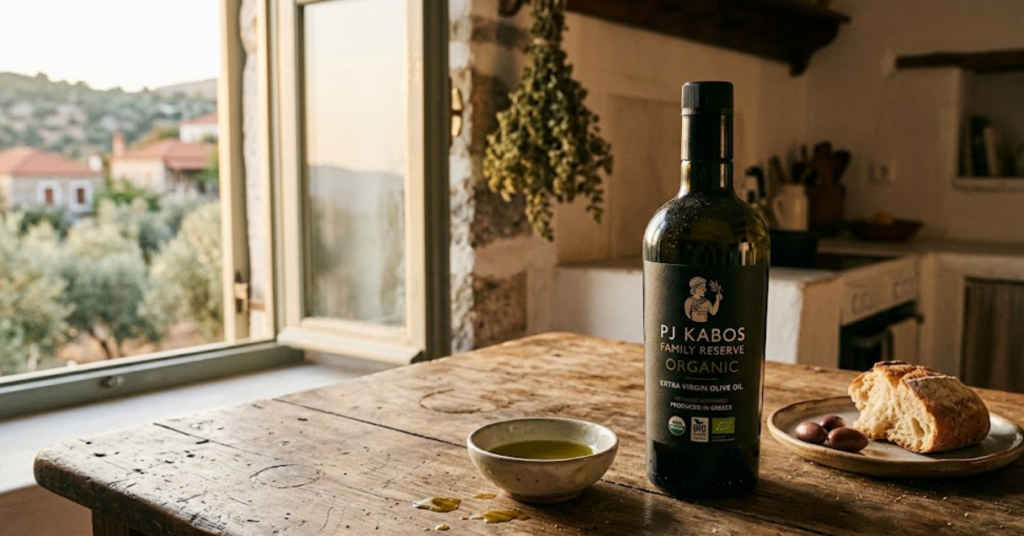
PJ Kabos Family Reserve Organic
Greece
400–900+ (lab verified)
✅ Gold 2025
✅ Yes
Health-first buyers
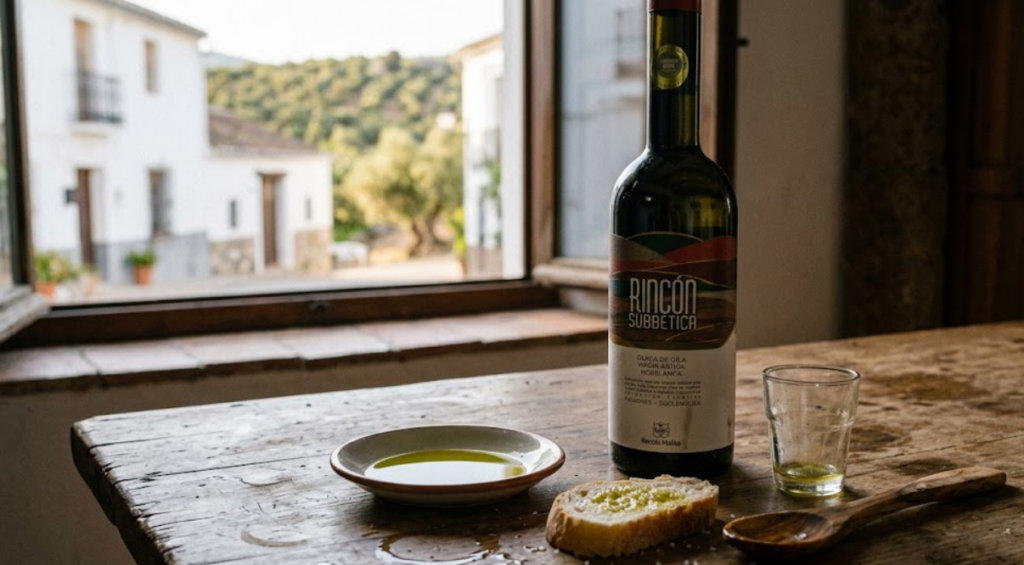
Rincón de la Subbética
Spain
348–393 (published)
✅ Gold 2025
✅ Yes
Flavor enthusiasts
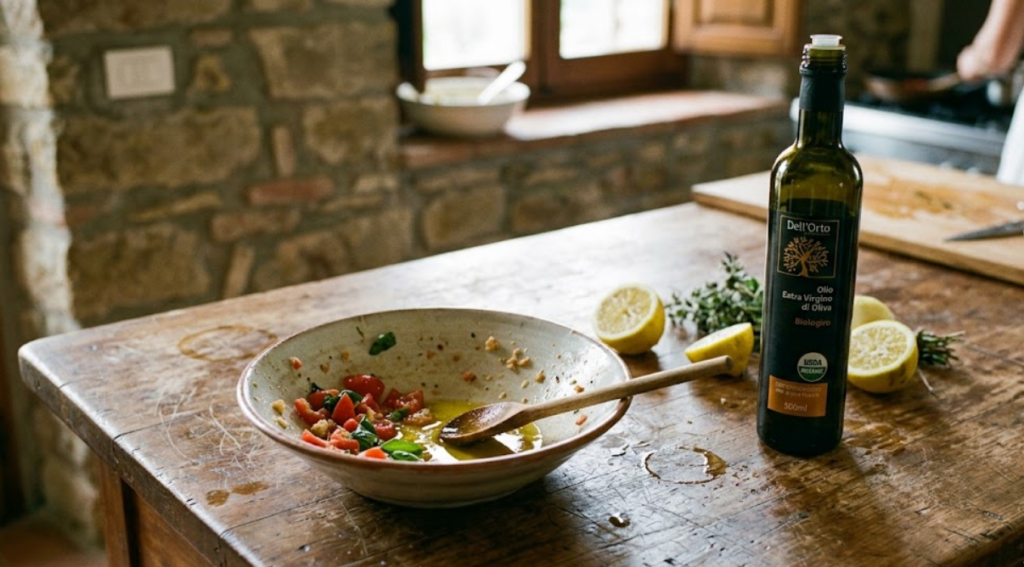
Dell’Orto Organic
Italy
Not published
✅ Gold 2025
✅ Yes
Artisan/gift pick
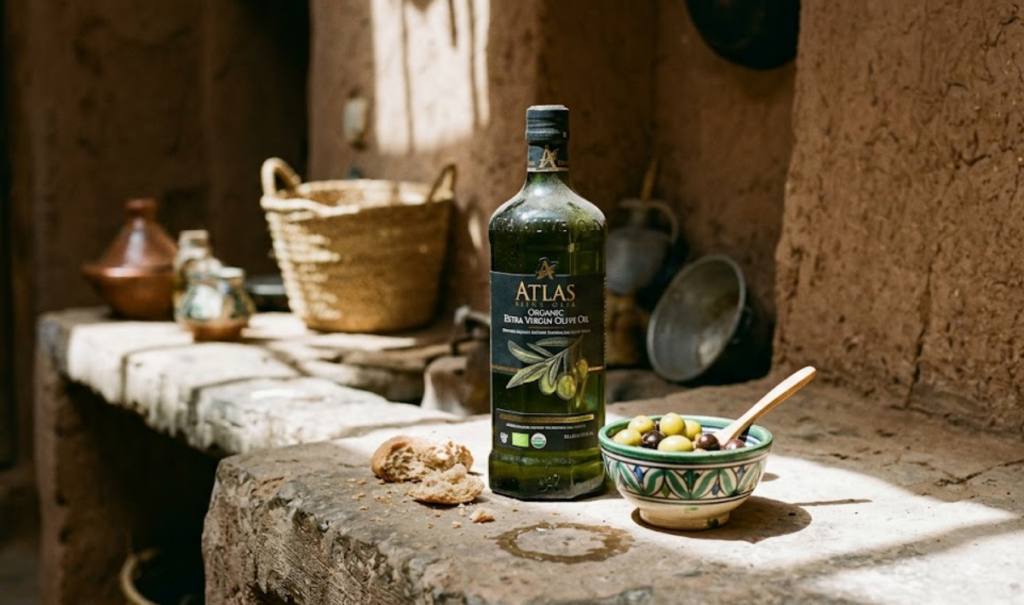
Atlas Organic
Morocco
~280–350 (estimated)
International awards
✅ Yes
Everyday value
Sky Organics
Greece
Not published
❌ None found
✅ Yes
Budget / entry-level
PJ Kabos Family Reserve Organic (Greece)
If polyphenols are your priority, nothing on this list comes close. PJ Kabos publishes HPLC-verified polyphenol counts for every variant, between 400 mg/kg on their medium intensity option and 900+ mg/kg on their Phenolic Shot. The EU health claim threshold for olive oil polyphenols is 250 mg/kg. Their flagship blows past it by a factor of three or more.
The olives come from a family estate near Ancient Olympia in Greece, hand-harvested in September and October each year. The 2025/26 harvest is already available with a best-before of December 2027, and the harvest date is printed on the label, not buried. They won multiple Gold Medals at the 2025 NYIOOC, including at the Biol and Biolnovello competitions in Italy. The testing method they use is HPLC, the only method the International Olive Council officially recognizes.
The honest caveat: the high-polyphenol variants are aggressively bitter. Around 10 to 15 percent of buyers find the Phenolic Shot unbearable and end up using it as a daily supplement shot rather than a cooking oil. For everyday cooking and finishing, their Medium variant (400+ mg/kg) is the more practical pick. Price sits around $35 to $60 for 500ml depending on variant, which is a significant premium over supermarket EVOO but not unreasonable for verified therapeutic-grade oil.
Best for: Anyone tracking inflammation markers, following a Mediterranean diet intentionally, or who wants maximum verified polyphenol content and full transparency on what they’re actually buying.
Rincón de la Subbética (Spain)
This one has 170+ international awards and a consistent place in the global Top 50 olive oils. It won Gold at the 2025 NYIOOC, and the producer, Almazaras de la Subbética, is regularly described as the world’s most awarded olive mill. That is not marketing. It is a verifiable competition record going back years.
The oil comes from 100% Hojiblanca olives grown in the Sierras Subbéticas Natural Park in Córdoba, Spain, at altitude between 700 and 1,000 meters. The trees are centuries old. The microclimate, high rainfall combined with large temperature swings, stresses the olives in a way that concentrates flavor and polyphenols. Published polyphenol content sits at 348 to 393 mg/kg depending on harvest year, acidity at just 0.14%, which is exceptionally low. The harvest date is disclosed: Fall 2024. It also carries PDO (Protected Designation of Origin) status, meaning every stage from grove to bottle is regulated and traceable.
The flavor profile is one of the most complex on this list. Thyme, mint, tomato vine on the nose. Green almond on the palate, finishing with a clean, lingering spice. Available on Amazon and through specialist retailers like Olive Oil Lovers. Around $25 to $35 for 500ml.
Best for: People who want an award-winning, verified-quality organic olive oil they can actually taste. This is the one to put on the table when it matters.
Dell’Orto Organic (Italy)
Dell’Orto is a fifth-generation family operation based near the Amalfi Coast in Campania, pressing olive oil since 1870. Their organic EVOO won Gold at the 2025 NYIOOC and carries both USDA certification and CCPB Italian organic certification, meaning two separate bodies have verified the farming practices.
Every bottle has both a harvest date and a best-by date printed on it. The oil is first cold-pressed, bottled in dark glass, and sold in formats from 500ml up to 3 liters. The honest gap here is that Dell’Orto does not publish specific polyphenol counts in mg/kg. They reference high antioxidant content without putting a number to it. That is not a red flag given the awards record, but it does mean you are trusting the competition rather than the data sheet.
Amazon reviews sit at 4.8 stars. The review base is smaller than Atlas or Sky Organics, which is typical for a premium artisan producer not optimizing for mass Amazon volume. Price is similar to Rincón, around $25 to $35 for 500ml.
Best for: A gift, a dinner party, or anyone who wants Italian heritage and serious award recognition in a USDA-certified organic bottle.
Atlas Organic (Morocco)
Atlas is the crowd favorite for a reason. It has over 19,000 Amazon reviews at 4.7 stars, it is made by a fourth-generation Moroccan family estate operating since 1887, and it is one of the first olive oils in the world to achieve carbon neutral certification. The origin story is genuinely compelling: olives grown in harsh desert conditions at high temperatures develop elevated polyphenol content as a stress response, the trees producing more antioxidants to survive.
The honest problem is verification. Atlas claims high polyphenol content, and the peppery flavor profile supports this, but they do not publish batch-specific lab results. Distributor estimates put the range at around 280 to 350 mg/kg, which clears the EU health claim threshold but is not independently confirmed for each harvest. Users in r/oliveoil have flagged this directly. The harvest date is printed on the bottle, the packaging is dark glass or tin, and the USDA seal is genuine. These are all positive signals. The transparency gap is real but not disqualifying for everyday use.
Price runs roughly $20 to $35 for 500ml to 1 liter. Available on Amazon in multiple formats.
Best for: Daily cooking and finishing when you want a genuinely organic Moroccan oil with serious provenance and don’t need lab printouts to feel good about what you’re buying.
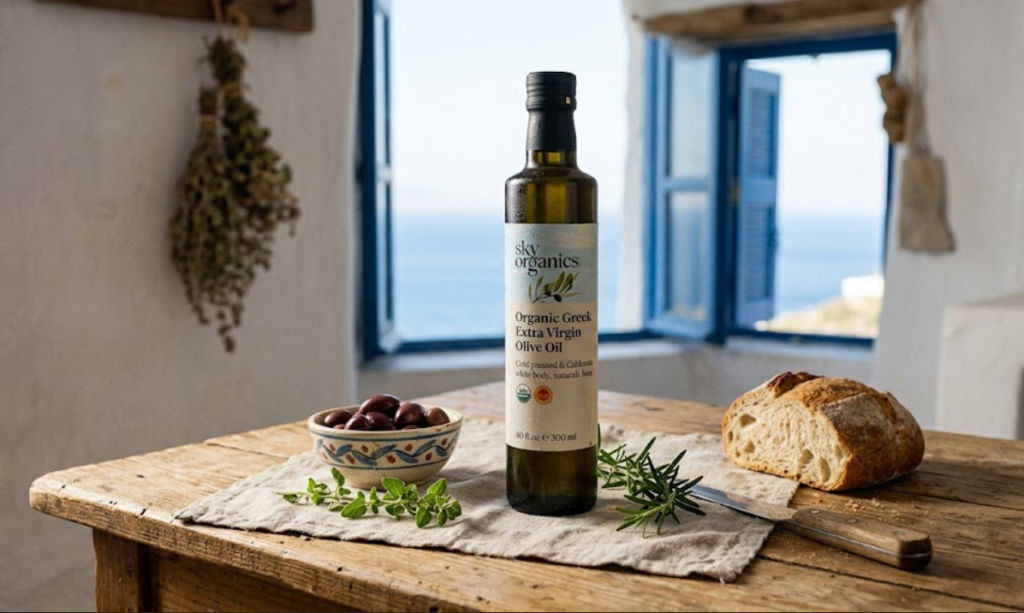
Sky Organics (Greece)
Sky Organics is the entry point. It is USDA Certified Organic, sourced from Greece, unfiltered, and bottled in dark glass. The harvest date is printed on the label, which already puts it ahead of most supermarket EVOOs that show only a vague best-by date. It is B Corp certified, meaning the company as a whole has been verified for social and environmental standards, not just this product.
What it lacks: no published polyphenol data, no NYIOOC recognition, and no independent lab verification we could find. A review analysis of nearly 3,000 Amazon reviews gave it a 92% trust score with a 4.6-star average. For a budget organic EVOO at $10 to $14 per 500ml, those are solid signals. The flavor is mild and approachable, which makes sense for a lower-intensity Greek oil. For everyday cooking where you are not finishing a dish raw, that is fine.
Best for: Anyone switching from conventional to organic olive oil for the first time, or cooking in volume where spending $50 per bottle is not realistic.
The Thing Nobody Tells You About Organic Olive Oil
The USDA Organic seal on your olive oil tells you one thing: the olives were grown without synthetic pesticides or fertilizers. It tells you nothing about whether the oil is actually good for you in the way most people assume.
Most people buy organic olive oil for the health benefits, the antioxidants, the oleocanthal, the polyphenols that give it anti-inflammatory properties. But the presence of polyphenols has almost nothing to do with whether the farm was organic. It has everything to do with three things the organic seal does not regulate: how early in the season the olives were harvested (earlier means more polyphenols), how quickly they were pressed after picking (hours matter, not days), and how the oil was stored before bottling.
You can buy a certified organic olive oil that was harvested from ripe, late-season olives, held in tanks for two weeks before pressing, and stored in clear glass under fluorescent lights, and it will have fewer polyphenols than a non-organic oil cold-pressed within four hours of an early harvest. The organic certification is a floor, not a ceiling. This is why harvest date and published polyphenol data matter more than the seal alone.
Research published by the National Institutes of Health confirms that olive oil polyphenols contribute to the protection of blood lipids from oxidative stress. The European Food Safety Authority set the health claim threshold at 250 mg/kg of hydroxytyrosol and its derivatives. Most supermarket olive oils, organic or not, never disclose where they sit on that scale.
What the Label Says vs. What It Actually Means
What It Says
What It Actually Means
Worth Paying For?
USDA Organic
No synthetic pesticides on the farm. Nothing about polyphenol content or oil quality.
Yes, as a baseline, not the full picture
Extra Virgin
Passes chemical and sensory standards. US enforcement is weak. Third-party certs add credibility.
Yes, but verify with competition awards or COOC seal if possible
Cold Pressed
Technically outdated terminology. Modern mills use centrifugal extraction. Means little on its own.
Only if it specifies temperature below 27°C
Harvest Date
The single most useful freshness signal on the label. Polyphenols degrade over time.
Yes, always look for this first
Polyphenol Count (mg/kg)
Lab-verified antioxidant content. HPLC is the gold standard testing method.
Yes, this is the signal that matters most for health claims
PDO / PGI Certified
Every stage of production is geographically regulated and traceable. Harder to fake than a brand claim.
Yes, adds meaningful verification on top of organic
Carbon Neutral
Emissions from production are offset. Not a quality signal for the oil itself.
If sustainability matters to you, yes
Our Honest Recommendation
If you are buying organic olive oil because you care about the health compounds and want to know what you are actually getting, buy PJ Kabos Family Reserve Organic in the Medium variant. It is the only oil on this list that publishes batch-specific, HPLC-verified polyphenol data. Everything else requires some degree of trust in the brand. PJ Kabos hands you the numbers.
If you care about flavor and want an oil with a serious pedigree, get Rincón de la Subbética. Gold at the NYIOOC, verifiable polyphenol count, PDO certification, and centuries-old trees. It is what you put on the table when you want to taste the difference.
If you want a premium Italian option with artisan heritage and strong award recognition but don’t need the data sheet, Dell’Orto is worth it. The 2025 NYIOOC Gold and 150 years of family production make it easy to feel confident about what you’re pouring.
If you just need a solid everyday organic olive oil that won’t break the budget, Atlas is the most practical choice for most households. The lack of published polyphenol data is a real limitation, but 19,000 Amazon reviews and a fourth-generation family farm behind it is not nothing.
And if you are switching from regular to organic for the first time, Sky Organics will do the job honestly without overcharging you.
The counterintuitive takeaway: organic is the floor. Look for the harvest date first, then the polyphenol count if published, then the competition record. An organic seal with none of those three is just a sticker.
If you are building out a genuinely clean pantry, our guides to best organic honey and best organic loose leaf tea follow the same approach: we go past the seal and look at what the certification actually covers.