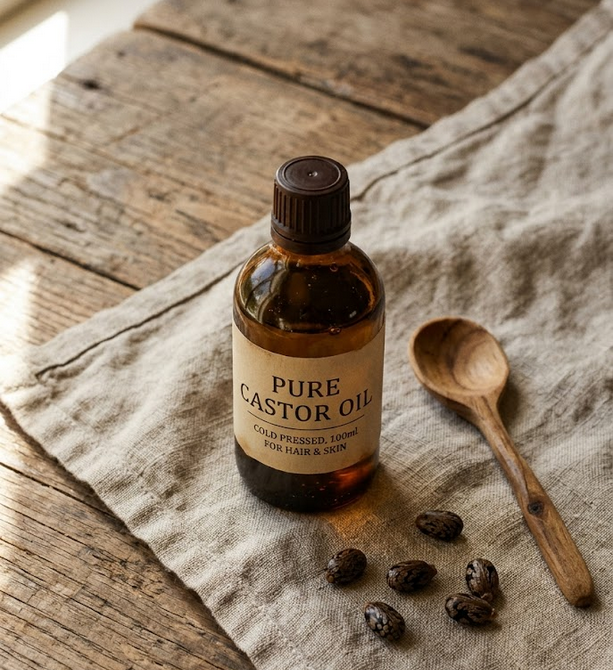
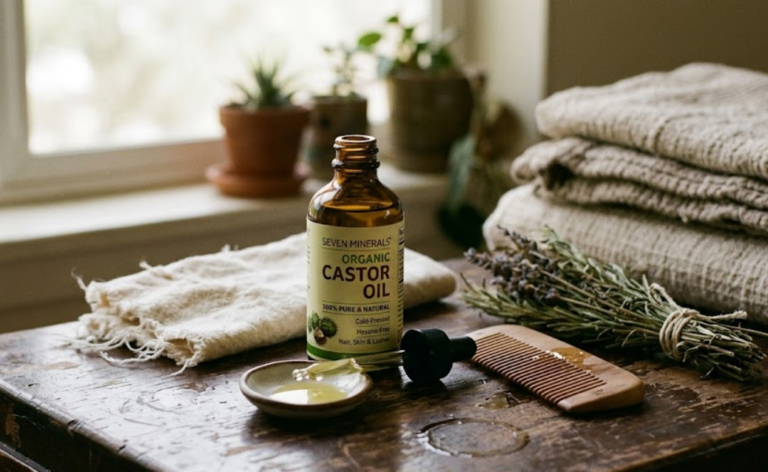
Cold pressed castor oil and hexane-extracted castor oil can look identical on a shelf. Same bottle, same label, sometimes even the same “organic” seal on the front. There are two ways to get oil out of a castor bean, and the difference between them is what you’re actually putting on your skin — not what the marketing says.
Hexane extraction is the commercial standard for most vegetable oils. It’s efficient, it maximizes yield, and the solvent evaporates off after processing. The issue is “evaporates off” isn’t the same as “completely removed.” Trace residues can remain in the final oil. For something you’re applying to your scalp, lashes, or skin daily, that matters more than it would for a cooking oil you heat to high temperature.
What Cold Pressed Castor Oil Actually Means
Cold pressing extracts oil by mechanical force without heat. The castor beans are crushed under pressure and the oil runs out. Nothing dissolves it. Nothing heats it. The process is slower and yields less oil per bean, which is why it costs more.
The practical benefit beyond no solvent residue: heat degrades ricinoleic acid, the primary active compound in castor oil that gives it its therapeutic properties. Cold pressing preserves it. A hexane-extracted, refined castor oil can look clean and odorless, but the stripping process that removes the solvent also removes some of the compound you actually want.
This is why cold pressed castor oil has a slight natural scent and a pale yellow tint. Refined oils are clear and nearly odorless. The refinement is not a quality upgrade. It’s a processing step that makes the oil more shelf-stable and visually appealing at the cost of purity.
Where USDA Organic Fits In
USDA Organic certification covers how the castor beans were grown — no synthetic pesticides, no synthetic fertilizers. That’s a meaningful baseline. What it doesn’t certify, at least not with the same enforcement rigour as the farming stage, is what happens during extraction and processing.
Most castor oil is sourced from India, which has centuries of castor cultivation history and genuinely produces high-quality oil. The issue is supply chain verification. Organic-certified beans can travel through multiple processing facilities before reaching a bottle, and not every step in that chain is audited with equal scrutiny. Cold-pressed and hexane-free claims on the label are the processing-stage verification that fills the gap.
In short: USDA Organic alone is not enough. You need the extraction method confirmed separately.
The Three Labels That Actually Matter Together
When buying castor oil, look for all three of these on the same product:
USDA Organic. Confirms the beans were grown without synthetic inputs. Baseline requirement, not the full picture.
Cold-Pressed. Confirms mechanical extraction without heat or solvents. This is the extraction method you want.
Hexane-Free. Explicitly confirms no petroleum solvent was used. Redundant if cold-pressed is genuine, but worth having as a stated claim given how loosely extraction is enforced across supply chains.
A product with one or two of these and not the third is worth questioning. A “100% pure organic castor oil” with no extraction method stated could be anything.
How to Spot a Brand Faking Cold-Pressed
The claim is easy to make and hard to verify without lab testing. A few tells worth knowing:
Price too low. Genuine cold pressed castor oil costs more to produce. A 16oz USDA organic cold-pressed option under $10 is worth questioning — not disqualifying, but worth a closer look at whether extraction method is actually stated or just implied.
“Expeller-pressed” listed instead of cold-pressed. Expeller pressing is mechanical but generates heat through friction. Some brands use it interchangeably with cold-pressed. They’re not the same thing, and brands that conflate them are either uninformed or hoping you won’t notice.
No extraction method stated at all. If a brand leads with “pure” and “organic” but never mentions how the oil was extracted, that’s the answer. Brands that cold press are proud of it. They say so clearly.
Cold pressed castor oil means no heat, no solvent, maximum ricinoleic acid preserved. Hexane-free confirms no petroleum residue. USDA Organic covers the farm. You need all three on the same label. Most products on Amazon don’t have all three. The ones that do cost a little more and are worth it for something you’re putting on your body every day.
For a full breakdown of which specific brands carry all three certifications, along with Amazon ratings and honest recommendations, see our organic castor oil brands roundup.