“Kills 99.9% of germs” is printed on enough cleaning products that most people assume one thing. That any list titled “natural disinfectants” describes the same category, just without the chemicals. It isn’t. The Environmental Protection Agency has a specific, narrow definition of what a “disinfectant” legally is. That definition has almost nothing to do with whether an ingredient is natural, or even whether it’s effective in a kitchen sink.
Under EPA rules, cleaning, sanitizing, and disinfecting are three different regulatory tiers, not three words for the same job. The EPA’s own guidance defines cleaning as removing dirt and organic matter. Sanitizing means reducing bacteria, but not viruses. Disinfecting means killing both bacteria and viruses, at a tested rate, within a specified contact time, using a product actually registered with the agency for that claim. Nothing about “natural” exempts a product from that bar. It just means almost nothing natural has been tested against it.
Take vinegar, the most common name on every list like this one, including earlier versions of this one. The EPA has not registered vinegar as a disinfectant. It doesn’t meet the agency’s own bar for the claim: killing 99.9% of harmful germs within 5 to 10 minutes. Vinegar’s acetic acid does measurably reduce certain bacteria, including E. coli and Salmonella, on hard surfaces. It does not reliably kill many others, and it does not touch the virus behind COVID-19. That makes it a real, useful cleaner. It does not make it a disinfectant, and no amount of diluting it in a spray bottle changes that.
This piece sorts each item below by what it actually does: cleans, sanitizes some things, or genuinely disinfects, based on real testing, not on what the ingredient sounds like it should do.
Where Each One Actually Lands
1. Vinegar: Cleaner, Not Disinfectant
White vinegar’s acidity breaks down grease, mineral deposits, and grime effectively. It does have measurable antibacterial action against some organisms. But it is not EPA-registered, and it does not meet the disinfectant kill standard. Use a 1:1 vinegar-and-water solution for everyday cleaning and degreasing. Don’t use it as a stand-in for disinfecting a surface after raw meat or illness in the house.
2. Hydrogen Peroxide: Genuinely Disinfects, With Conditions
Hydrogen peroxide is the one item on this list with a real path to an actual disinfectant claim. EPA-registered hydrogen peroxide products exist. They’re recognized as effective against a broad range of bacteria, viruses, and fungi, when used at the tested concentration and contact time on the label. The 3% solution sold at any pharmacy is not automatically that registered formulation. Pouring it on a countertop for thirty seconds is not the same protocol a registered product’s label specifies. Still, of everything on this list, hydrogen peroxide has the most legitimate underlying chemistry for the disinfectant claim.
3. Essential Oils: Antimicrobial in a Lab, Unproven on a Countertop
Tea tree, lavender, and eucalyptus oils show real antimicrobial activity in laboratory studies, at controlled concentrations, against specific organisms. A few drops in a spray bottle is a different thing entirely. Concentration, contact time, and the exact strain of bacteria on a kitchen counter are all unknowns. Essential oils are a reasonable way to add a pleasant scent to a cleaning routine. Treat any disinfecting claim attached to them as unverified for home use.
4. Citrus Extracts: Effective Degreaser
The d-limonene in citrus peels is a genuinely strong solvent for grease and grime. That’s why it shows up in commercial degreasers. Its antimicrobial evidence is much thinner than its cleaning evidence. Use citrus-based solutions for what they’re actually good at, cutting through kitchen grease, not replacing a disinfecting step.
5. Baking Soda: Cleaner and Deodorizer
Baking soda’s mild alkalinity and abrasive texture make it a solid scrubbing agent and odor absorber. Its ability to meaningfully raise a surface’s pH high enough to reliably kill bacteria or fungi is not well supported. It belongs in the cleaning category, not the disinfecting one.
6. Alcohol: Genuinely Disinfects, at the Right Concentration
This is the other real disinfectant on the list, with a specific requirement most people skip. The concentration has to be right. Rubbing alcohol or ethanol solutions need to sit at roughly 70% alcohol to reliably denature the proteins of bacteria and viruses. Too high a concentration and it evaporates before it can work. Too low, and it doesn’t do the job at all. Check the actual percentage on the bottle before assuming any “rubbing alcohol” product qualifies.
7. Castile Soap: Cleaner
Castile soap, made from vegetable oils, is a genuinely gentle and effective cleaner for countertops, floors, and fabric. Soap’s job is to lift dirt and oil away from a surface so it can be rinsed off. It’s not built to kill what’s left behind. Pair it with a genuine disinfecting step if that’s the actual goal.
8. Salt: Abrasive Cleaner
Coarse salt works as a mechanical abrasive for scrubbing away grime. It can also draw moisture out of a surface, which makes it harder for some organisms to thrive short-term. That’s a cleaning and mild inhibition effect, not a disinfecting one.
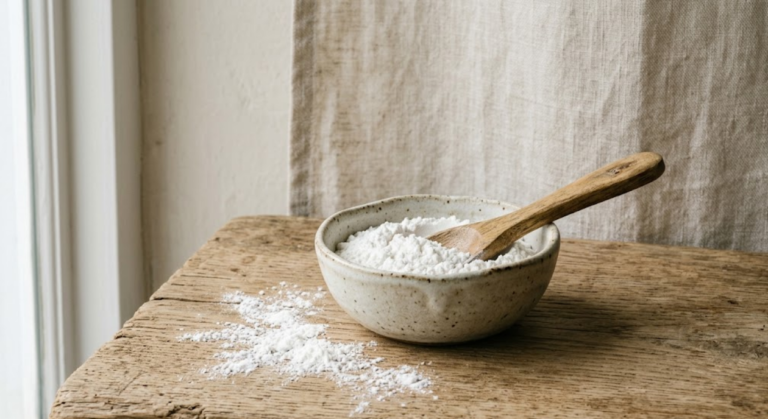
9. Cornstarch: Moisture Absorber
Cornstarch’s fine texture absorbs moisture and helps lift grime for wiping. That’s a genuinely useful cleaning trick, particularly on greasy surfaces. There’s no real evidence it kills bacteria. It just makes the surface less hospitable to them briefly, which is worth knowing before it’s relied on for anything more.
10. Thyme: The One Surprising Exception
This is the one place a “natural” ingredient actually clears the bar, just not in the form most people picture. Thymol, the active compound in thyme, is the registered active ingredient in real EPA-registered disinfectant products. It’s tested and approved against a defined list of bacteria and viruses, at a specific formulation. Steeping dried thyme leaves in hot water at home is not that formulation, and hasn’t been tested the same way. The honest version of this entry: thymol-based disinfecting is real and EPA-recognized, but only in products actually built and registered around it. Not in a homemade tea.
The Thing Nobody Tells You
Of the ten items above, exactly two have a real, EPA-recognized path to killing viruses at a tested rate: hydrogen peroxide and thymol. Both only count in a properly formulated, registered product, not the raw, homemade version most lists describe. Everything else on a typical “natural disinfectant” list, vinegar, citrus, baking soda, castile soap, salt, cornstarch, is a genuinely good cleaner. Cleaning and disinfecting solve different problems. Cleaning removes the dirt a germ needs to survive on a surface. Disinfecting kills the germ itself, at a measured rate, within a set time. For everyday counters and floors, a good clean is often the right amount of effort. For a surface after raw meat, illness in the house, or anything genuinely high-risk, reach for an EPA-registered disinfectant instead, natural-ingredient or not. That’s the tool actually built and tested for the job.
The small, specific ask here isn’t to throw out the vinegar spray. It’s to stop calling it a disinfectant, and to keep one actual EPA-registered disinfectant on hand for the moments that call for one.