If you’ve seen mushroom packaging arrive in a box from Dell, IKEA, or a small furniture company, the story you probably heard was about the end: that you can break the pieces apart and put them in your compost bin, and the material disappears in a matter of weeks. That part is true, more or less. It’s also the least interesting part of why this material matters.
The stronger argument for mushroom-based packaging has almost nothing to do with what happens after you’re done with it. It has to do with what didn’t have to happen to make it.
Some links in this article are affiliate links. No brand paid to be included.
What mushroom packaging actually is
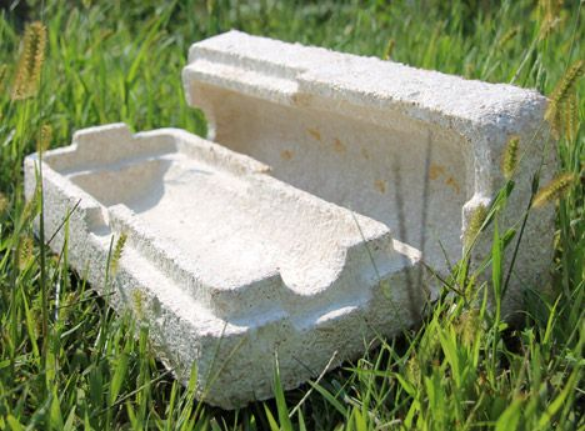
The material that most people mean when they say “mushroom packaging” is MycoComposite™, developed by Ecovative Design, a company founded in 2007 by two Rensselaer Polytechnic Institute graduates. It is not made of mushrooms in the sense of caps and gills. It’s made of mycelium (the root-like network that mushrooms grow from) bonded to hemp hurd, which is the fibrous woody core left over after hemp stalks are processed for fiber. The hurd is an agricultural byproduct that would otherwise be waste.
The process runs at room temperature, in the dark, with no petrochemical inputs. Agricultural waste goes in. A mold shapes the material. Mycelium grows through the hurd over roughly seven days, binding it into a rigid, lightweight composite. The material is then heat-treated to stop the mycelium from growing further. No blowing agents, no polymer resins, no toxic off-gassing during manufacturing.
That last detail is where the comparison with conventional foam packaging gets interesting.
What goes into making regular foam packaging
Expanded polystyrene foam (EPS), the white, crumbly material in most appliance and electronics packaging, is manufactured by expanding polystyrene beads using pentane gas as a blowing agent. Pentane is a volatile organic compound released during that process and a contributor to ground-level ozone formation.
The monomer that polystyrene is built from, styrene, carries a separate concern. In 2019, the International Agency for Research on Cancer upgraded styrene’s classification from Group 2B (possibly carcinogenic) to Group 2A (probably carcinogenic). That classification applies primarily to occupational exposure in manufacturing settings. The consumer risk from finished, intact foam products is much lower. Even so, styrene is a known off-gasser from polystyrene containers in contact with hot food or beverages, which is why a number of cities have moved to ban foam food containers specifically.
Mushroom packaging sidesteps all of this. The inputs are hemp hurd and mycelium; Ecovative hasn’t published the full methodology, but a life cycle assessment they reference puts their material’s energy use at roughly a tenth of an equivalent volume of foam, with greenhouse gas emissions at about an eighth. The directional logic is consistent with the process: growing mycelium at room temperature on agricultural waste is inherently low-energy compared to petroleum-derived polymer manufacturing. Independent verification of those specific figures doesn’t yet exist.
The composting question (and the infrastructure problem)
The compostability claim is what brands lead with, and it’s worth examining on its own terms.
Ecovative says Mushroom® Packaging breaks down in 45 days in home compost. They hold BPI certification (Biodegradable Products Institute, verifying to ASTM D6400 soil toxicology standards), Cradle to Cradle Gold certification, and the USDA Biobased Preferred mark. The recommended disposal method is to break the packaging into pieces and add it to a home compost pile or garden bed, where it reverts to soil nutrients without energy-intensive processing.
The limitation is specific. Active home composting requires the right conditions: moisture, oxygen, and microbial activity working together. A dry heap in the corner of a yard doesn’t produce those conditions. A sealed landfill absolutely doesn’t. Landfills are largely anaerobic environments with minimal moisture movement, and organic materials break down extremely slowly there. Mushroom packaging in a landfill still outperforms EPS foam (which doesn’t meaningfully biodegrade on human timescales), but it isn’t the “disappears in weeks” story.
The access problem makes this more concrete. According to BioCycle’s 2023 survey, roughly 10 million US households have access to curbside organics collection, out of approximately 130 million total. For the large majority of people, whatever sustainable packaging arrives in a delivery box ends up in the regular bin regardless of what the label says. This doesn’t make compostable packaging pointless. However, having a home compost pile (if one is available) becomes the actual deciding variable, not the certification on the material.
Where to find it as a consumer
Mushroom packaging is primarily a B2B product. Dell has used it for laptop packaging since 2012. IKEA piloted it for some product lines. A number of smaller brands in furniture, wine shipping, and specialty food have adopted it. Most people encounter it as something that arrives in a box, not something they go looking for.
Ecovative does sell void-fill and protective packaging materials directly through mushroompackaging.com, and some formats are available through Amazon. For small businesses or individuals shipping fragile items, this is a real alternative to packing peanuts or foam inserts. Per-unit cost is higher than bulk foam alternatives, but for lower-volume use (where foam is often sold in larger minimums than you actually need), the gap closes. For brands where unboxing is part of what they’re selling, the material has a texture and appearance that foam doesn’t.
For European buyers, the Magical Mushroom Company (UK) and Grown.bio (Belgium) offer similar mycelium packaging options. Neither has significant US consumer-facing retail presence.
The thing nobody tells you about mushroom packaging
The packaging industry defaults to end-of-life comparisons: this material biodegrades, that one doesn’t. That distinction is real. It’s also the wrong frame for understanding why mushroom packaging is genuinely different.
For most materials, the environmental impact is front-loaded. The carbon, the toxins, the energy use are largely spent before the packaging leaves the facility. EPS foam carries styrene, pentane, and petroleum chemistry into every box it lines. The fact that it also doesn’t biodegrade is the visible problem; the manufacturing footprint is the less visible one.
Mushroom packaging’s actual advantage is that it skips that front-loaded cost entirely. Mycelium grows on waste feedstock at ambient temperature, with no toxic chemistry required. Whatever happens at the end of its life is a secondary consideration. The damage that didn’t happen is the main event.
The composting benefit is real, particularly if you have a home pile or curbside organics access. But the packaging that arrived in that box already did its most important work before it reached you. The compost bin story is the coda, not the argument.
What to do when it shows up
If you receive mushroom packaging in a delivery:
Break it into smaller pieces and add it to a home compost bin or garden bed. It returns organic matter to the soil as it breaks down over weeks to months, depending on conditions.
If you have curbside organics collection, it can go in that bin. Check with your local program first, as some specify what they accept.
If neither option is available, it still goes in the landfill. That is a worse outcome than composting. The material’s production footprint was already lower than foam from the start.