Most comparisons between LED Christmas lights and traditional ones end quickly. LEDs use less energy. They last longer. Buy LEDs. That’s the whole article.
The energy savings are real. Run a 7-watt LED string for 6 hours a night across a 45-day season at 14 cents per kilowatt-hour, and it costs about $3.12. The comparable 40-watt incandescent string costs $17.82. That math doesn’t change by brand or by year.
But the assumption underneath most of these guides is that the light itself looks the same. Buy LEDs, same visual result, lower bill. That’s the part that doesn’t hold.
What “Warm White” Means on a Box vs on Your Tree
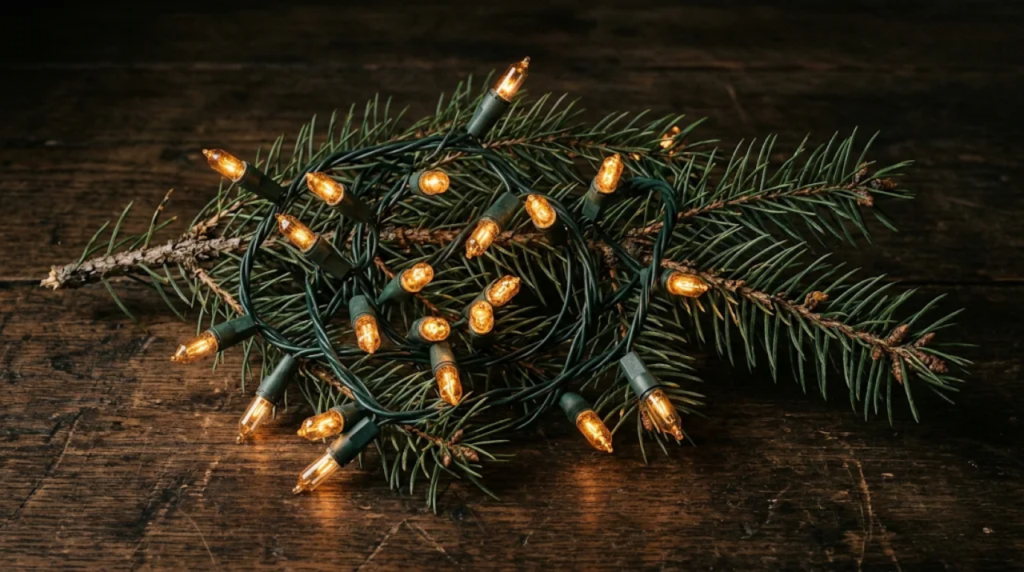
Traditional Christmas lights, like all incandescent bulbs, produce light through a heated filament. The physics of that process puts their color temperature at around 2,700 Kelvin. That’s the specific amber-gold tone most people picture when they think of a decorated Christmas tree.
LED color temperature is set during manufacturing. And “warm white” on an LED box covers a wider range than 2,700K. Many strings sold as warm white are calibrated to 3,000K, 3,200K, or higher. All of those are technically warm. But set them next to a traditional incandescent string and they read slightly cooler. Crisper. Less amber.
The 2,700K LEDs exist. They’re less common on retail shelves and rarely specified on the front of the box. Usually you have to find the spec in the product listing, the detailed product page, or a downloadable spec sheet. Sometimes it isn’t listed at all.
This is where the “warm white” label stops being useful. It tells you the direction without telling you the degree.
CRI: Why Your Ornaments Look Different
Color Rendering Index (CRI) measures how accurately a light source shows colors compared to natural daylight. The scale goes from 0 to 100. Incandescent bulbs, including traditional Christmas lights, sit at or near 100. It’s a consequence of their physics, not a design choice.
Most LED Christmas lights have a CRI around 80. That’s considered acceptable for general lighting. But it means the reds on your ornaments are slightly less saturated, the greens on the garland slightly more muted, the golds a bit flatter than they’d look under true-spectrum light.
An 80 CRI rating and a 95 CRI rating look almost identical on a plain white ceiling. On a decorated tree with deep reds and rich greens, the difference shows. Not dramatic. But there. If the tree looks slightly less vivid than you expected, CRI is usually the reason.
Higher-CRI LED strings exist and cost more. They’re also rare in the Christmas lights category specifically. For most shoppers, 80 CRI is the realistic baseline.
What LED Gets Unambiguously Right
The energy savings hold across every brand at every price point. Roughly 80% less electricity, every time.
LEDs don’t heat up. Traditional incandescent strings get warm to the touch. LEDs stay cool, which matters for dry tree branches, fabric decorations, and anything stored near the lights in a box.
Lifespan: a quality LED string is rated at 25,000 hours or more. Traditional incandescent bulbs run 1,000 to 3,000 hours. For seasonal use, that’s essentially the whole life of the product. The string is more likely to get damaged in storage than to burn out from use.
And if you want color-changing modes, app control, or smart home integration, that’s LED territory. Traditional strings don’t go there.
Where the Difference Is Still Real
Mixing old and new strings is where the visual gap is most obvious. Adding a few LED strings to a tree that already has incandescent ones means they won’t match. The color temperatures are different enough to read as two distinct light sources on the same display.
Individual bulb replacement is easier with traditional strings. Most LED strings don’t offer it. A failed section typically means replacing the full string. Given the lifespan gap, this rarely comes up in practice. But it’s the one area where incandescent design is more user-serviceable.
Dimmability varies. Standard LED strings often don’t play well with dimmer switches. If you’re running lights through a smart plug set to dim, check the product specs before assuming compatibility.
The Actual Decision
The energy case for LED is settled. The question is whether you care about matching the visual character of traditional incandescent light, and how much time you’re willing to spend on specs to get it.
If you want the closest match to classic incandescent warm white, look for LED strings explicitly listed at 2,700K. That spec is findable. It just takes more than reading the front of the box.
If you’re replacing a full set rather than mixing old and new, the perceived color gap is less noticeable. A tree lit entirely by modern LED warm white looks warm. It doesn’t look identical to a tree lit by incandescent. Most people won’t notice. Some will.
So the real question isn’t LED vs traditional. It’s which aspect of “traditional” you’re trying to preserve. The energy cost is easy to change. The light it produces is not as simple to replicate.
For specific product picks across warm white and color-changing LED strings, including which brands actually spec 2,700K, see our energy efficient Christmas lights roundup.