Pomegranate has one of the strongest health halos of any fruit on the shelf. It shows up in juice aisles, supplement capsules, and skincare labels trading almost entirely on one word: antioxidants. So when a jar says “organic pomegranate powder,” most buyers assume they are getting a concentrated version of the whole fruit.
That assumption is usually wrong, and the label rarely corrects it.
Almost every product sold under “organic pomegranate powder,” including every major brand on Amazon’s first page of results, is actually pomegranate juice powder. It is made by extracting and drying the juice from the arils, the juicy seed sacs inside the fruit. The peel and the white pith around it, the parts of the fruit that carry the highest concentration of the compound pomegranate is actually known for, get discarded before the powder is ever made.
That compound is punicalagin, an ellagitannin unique to pomegranate. Published phenolic-profiling research measures punicalagin at roughly 10,500 to 20,300 mg/kg in the peel and mesocarp, compared to a few thousand micrograms per liter in aril juice, several orders of magnitude apart on a fair basis. Whole-fruit homogenates, made by pressing the entire fruit rather than just the arils, show roughly 20 times higher antioxidant activity than aril juice alone in direct laboratory comparisons.
None of this makes juice powder useless. A teaspoon of aril juice powder still concentrates real, meaningful polyphenol content, roughly equivalent to what you would get from four ounces of fresh pomegranate juice. It is a legitimate product doing what it says on the label, once you understand what the label actually means. The issue is that “pomegranate powder” and “pomegranate juice powder” get used almost interchangeably in marketing, and only one of them delivers the whole-fruit antioxidant profile people picture when they buy it.
Some links in this article are affiliate links. No brand paid to be included.
Comparison Table
| Brand | Product Type | Testing Disclosed | Best For |
|---|---|---|---|
| Navitas Organics | Aril juice powder | Third-party tested (company claim, no public COA found) | Everyday smoothie use, established B Corp brand |
| Z Natural Foods | Aril juice powder | FDA-registered facility, batch and supplier testing (company claim) | Buyers who want documented facility-level quality controls |
| Anthony’s Goods | Aril juice powder | No public COA for this product; company’s almond flour tested positive for lead in independent third-party testing (different product) | Bulk value, widely available |
The Brands
Navitas Organics Pomegranate Powder
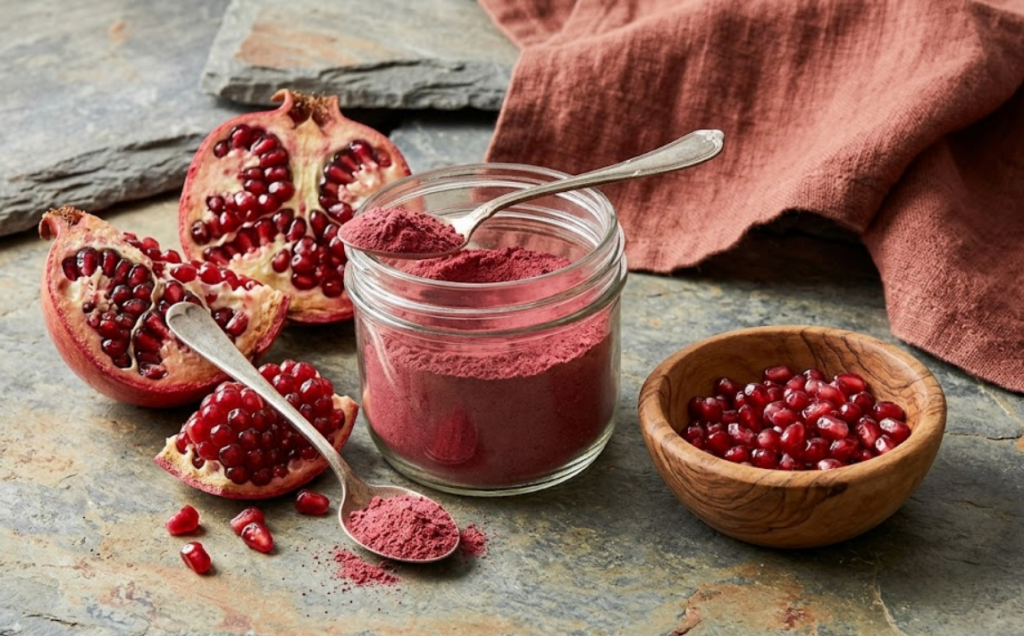
✅ USDA Certified Organic | ✅ Non-GMO, Kosher, Gluten-Free | ✅ B Corp certified | Buy on Amazon
Navitas sources its pomegranate from sun-ripened fruit grown in India, one of the world’s oldest pomegranate-growing regions, and states that all of its products go through third-party independent lab testing for heavy metals, microbials, and nutrition. No public certificate of analysis for this specific product turned up during research for this article, so that claim currently rests on the company’s word rather than a document a buyer can check directly. Navitas carries B Corp certification, which requires third-party verification of business practices generally, though not specifically of contaminant testing.
This is an aril juice powder, not a whole-fruit powder, the same as every other brand in this roundup. It delivers real, concentrated polyphenol content from the juice, just not the peak punicalagin levels found in the peel and pith.
Best for: buyers who want an established, widely-available brand for everyday smoothie use and are comfortable with a company testing claim rather than a published COA.
Z Natural Foods Organic Pomegranate Juice Powder
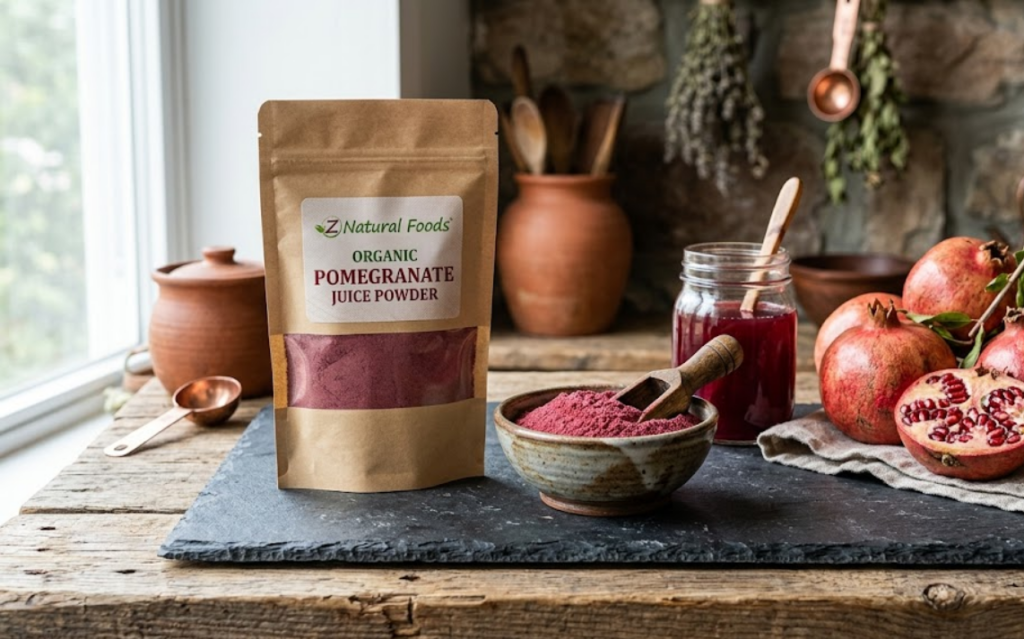
✅ USDA Certified Organic | ✅ Kosher Certified | ✅ FDA-registered, cGMP facility | Buy on Amazon
Z Natural Foods operates an FDA-registered production facility, certified organic by Baystate Organic Certifiers and Kosher certified by Earth Kosher. The company states it runs batch testing for microbial analysis and heavy metals, and requires suppliers to pass FDA Foreign Supplier Verification Program checks along with their own lab analysis before ingredients are accepted. As with Navitas, this is a facility-and-process-level claim rather than a published, per-batch COA a buyer can pull up directly.
Same category, same caveat: aril juice, not whole fruit.
Best for: buyers who weigh facility-level certifications and supplier verification programs as a meaningful trust signal.
Anthony’s Organic Pomegranate Juice Powder
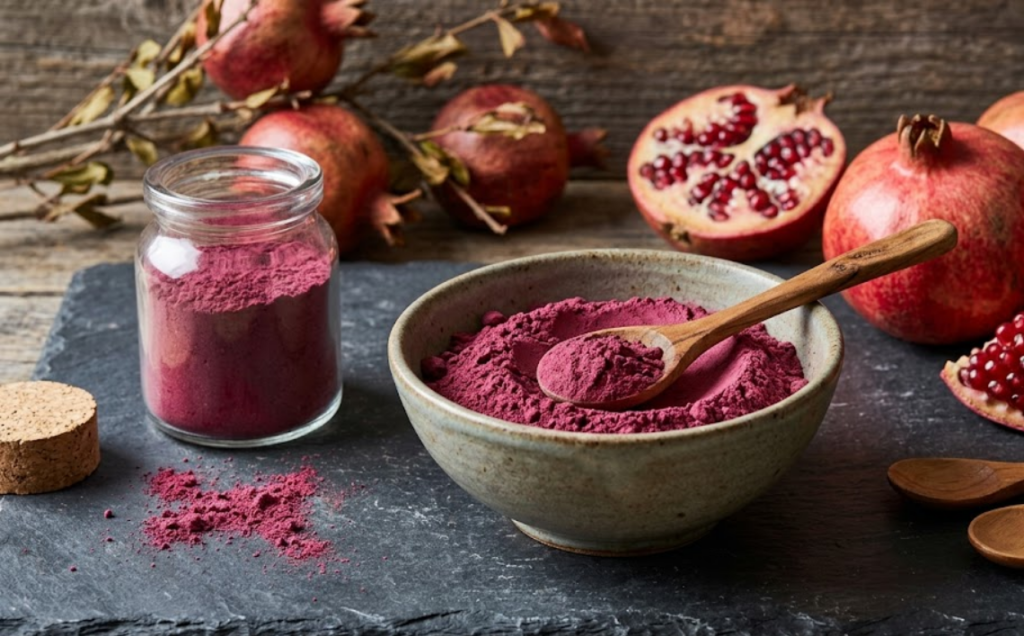
✅ USDA Certified Organic | ✅ Gluten-Free, Non-GMO, Vegan | ✅ Cold-pressed and freeze-dried | Buy on Amazon
Anthony’s is a widely available bulk ingredient brand, owned by ACH Food Companies, a larger industrial baking and oil manufacturer, since 2019. Their Organic Almond Flour tested positive for concerning lead levels in independent, community-funded third-party lab testing conducted by Lead Safe Mama in 2025. That result applies to the almond flour, a different product with a different supply chain, not this pomegranate powder, and no independent testing of this specific product turned up in either direction. A buyer weighing which company to trust deserves that context even without direct evidence against this particular item.
Also an aril juice powder, sourced and processed the same way as the other two brands here.
Best for: buyers prioritizing price and availability who are comfortable weighing a different-product contamination history against this specific item having no confirmed issue.
The Thing Nobody Tells You: Juice Powder Is Not Whole-Fruit Powder
Pomegranate’s reputation rests on punicalagin, an ellagitannin that does not occur in most other fruit. The compound is not evenly distributed through the fruit. It concentrates heavily in the peel and the white mesocarp, the parts nobody eats and every juice powder brand discards before drying.
Published phenolic-profiling studies put punicalagin content in pomegranate peel and mesocarp at roughly 10,500 to 20,300 mg/kg. Aril juice, the part that becomes juice powder, measures in the low thousands of micrograms per liter, a difference of several orders of magnitude on a fair comparison basis. Separately, homogenates made by pressing the whole fruit, peel included, show roughly 20 times higher antioxidant activity than juice made from arils alone.
Ellagitannins like punicalagin are not directly absorbed by the human body in their raw form. Gut bacteria convert them into ellagic acid and further into compounds called urolithins, and that conversion happens regardless of whether the ellagitannins came from peel or juice. Bioavailability research on this pathway is still developing, and raw concentration numbers do not map cleanly onto how much benefit actually reaches the bloodstream. Juice powder is not worthless, and peel is not automatically superior in every practical sense.
The numbers do establish that “pomegranate powder” as a category name overstates what most products in it actually contain. A teaspoon of aril juice powder concentrates real polyphenols, genuinely comparable to a few ounces of fresh juice. It does not concentrate the fruit’s full antioxidant profile, because the part of the fruit carrying most of that profile was never part of the product.
Anyone specifically chasing the compound pomegranate is known for at something closer to its full concentration should look for products that explicitly include peel or pith, not just arils or juice. These exist, but rarely surface in a plain “organic pomegranate powder” search, since most search and marketing language treats “pomegranate powder” and “pomegranate juice powder” as interchangeable. Whole-fruit blends and dedicated peel powders sit in a separate, smaller category worth searching for by name. We break down the gut-conversion mechanism behind all of this, and what it actually means for how much of this compound your body can use, in our companion piece on how punicalagin actually becomes usable in the body.
| Term on the Label | What It Actually Guarantees | What It Doesn’t |
|---|---|---|
| “Pomegranate Powder” | Contains dried pomegranate in some form | Whether that form is juice, arils, peel, or a blend |
| “Pomegranate Juice Powder” | Made from extracted, dried juice, typically from arils | Peel or pith content, where most punicalagin concentrates |
| “Antioxidant-Rich” | The product contains some measurable antioxidant compounds | A specific tested amount, or that it matches whole-fruit levels |
| USDA Organic | Growing inputs were certified organic | That the product was independently tested for heavy metals or contaminants |
| “Third-Party Tested” | Some form of independent testing occurred, per company claim | Which tests, which batch, or whether results are published for buyers to check |
Honest Recommendation
All three brands here are aril juice powders, and all three are reasonable choices for what a juice powder actually delivers: real, concentrated polyphenol content in a convenient, shelf-stable form. None are whole-fruit powders, and none currently publish a per-batch certificate of analysis a buyer can check directly. Their testing claims rest on company statements about facilities and processes rather than documents anyone can pull up independently.
Navitas and Z Natural Foods carry no confirmed contamination history in independent testing found during research for this piece. Anthony’s does, on a different product in its line, its almond flour, not this pomegranate powder, which is worth knowing even though it is not direct evidence against the product reviewed here.
Buying for convenience, flavor, and a real but moderate polyphenol boost? Any of these three does that job. Chasing punicalagin at its highest natural concentration specifically? None of them get there, since that requires peel and pith, not juice, and finding it means searching for a whole-fruit or peel-inclusive product by name rather than trusting the word “pomegranate” on a juice powder label to mean what it sounds like it means.
For more on how labels quietly narrow what a product actually contains, see our breakdowns of what “wildcrafted” actually means for sea moss and what beetroot powder labels don’t tell you.