USDA Organic certification verifies one thing: whether a farmer grew and processed a crop without synthetic pesticides, herbicides, GMOs, or chemical fertilizers. It says nothing about what was already in the soil. It also says nothing about what the organic standard itself still permits farmers to add.
In our organic arrowroot powder roundup, we flagged a real number. Independent lab testing found 6 parts per billion of lead in Bob’s Red Mill Premium Quality Arrowroot Starch, which carries USDA Organic, Non-GMO, and gluten-free certification. That single data point raises an obvious question: if the product carries organic certification, where does the lead actually come from, and why doesn’t the certification catch it?
How lead gets into a root vegetable in the first place
Heavy metals like lead don’t come from the plant. They come from the soil the plant grew in, and from whatever farming adds to that soil. Trace lead occurs naturally in soil almost everywhere. Plants take up whatever’s available through a well-documented uptake pathway: roots absorb metals dissolved in soil moisture and distribute them into the plant’s tissue, including the parts we eat.
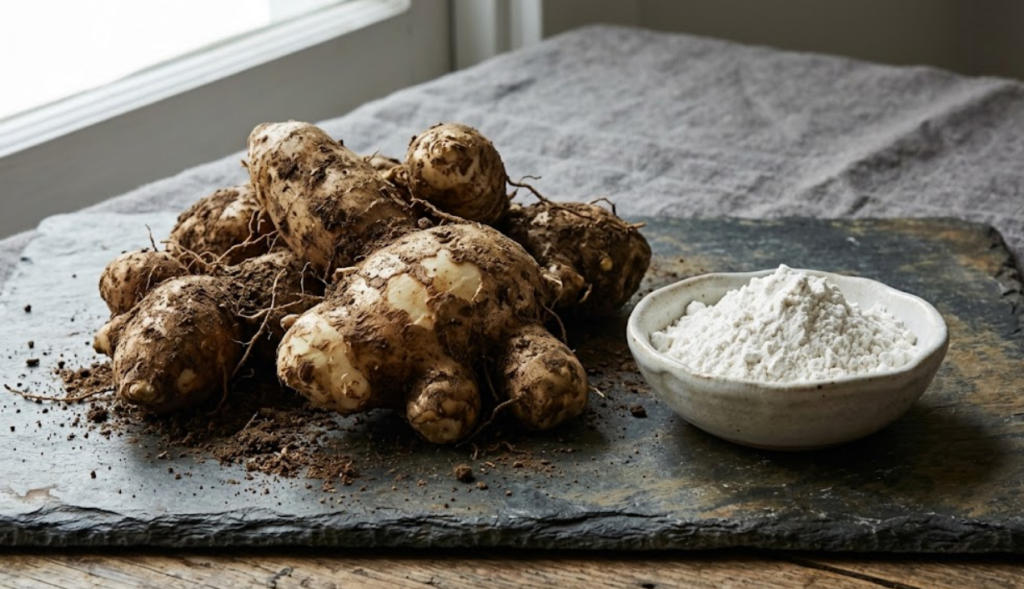
Root and tuber crops differ structurally from a leafy green or a fruit here. The edible part of an arrowroot plant is the rhizome itself, the exact tissue that sits in direct, sustained contact with the soil. A tomato or an apple grows above ground, removed from that contact. A carrot, a beet, an arrowroot rhizome never gets that separation. This isn’t a guess specific to arrowroot. The FDA’s own January 2025 lead guidance shows it directly: the agency set a 20 ppb allowance for single-ingredient root vegetables, double the 10 ppb allowance for most other produce categories. In other words, the FDA drew that distinction because root vegetables structurally run higher, not because of how any particular brand farms.
Why “organic” doesn’t close this gap
Organic farming isn’t doing anything wrong here. Organic rules target synthetic inputs, not heavy metals. Even so, several inputs organic farming explicitly allows turn out to be real vectors for that exact risk.
According to the Rodale Institute, a nonprofit organic-farming research organization, organic farms can use manure from conventionally raised animals as a fertility input. Conventional feed can include additives that carry trace arsenic, which passes through into the manure and then into the soil it fertilizes. Organic rules also allow phosphate rock as a natural mineral fertilizer, and depending on the source, those mineral deposits can themselves carry cadmium and arsenic. Compost carries its own risk too: repeated applications build up over time, and compost doesn’t break heavy metals down the way it breaks down organic matter. Metals are elemental. They don’t degrade. They concentrate.
None of that violates organic certification. USDA organic rules do require producers to manage soil in a way that avoids heavy metal contamination, but the regulation stops there. It sets no contamination limits, and it requires no testing. Each individual operation decides for itself whether to actually screen its soil or its inputs for heavy metals. Some do. Nothing in the certification requires it.
The numbers, side by side
People cite three different lead thresholds in conversations like this, and they’re not interchangeable. Worth having them in one place.
Threshold
Value
Source & status
What it actually applies to
Advocacy-recommended target
5 ppb
2021 medical and scientific community recommendation, not a government rule
Cited by independent testing groups as an aspirational benchmark for infant/toddler food
FDA finalized guidance, general
10 ppb
FDA, finalized January 2025, “Closer to Zero” initiative
Most processed foods marketed for babies and toddlers under two
FDA finalized guidance, root vegetables & dry infant cereal
20 ppb
FDA, finalized January 2025, same guidance
Single-ingredient root vegetables and dry infant cereals marketed for babies and toddlers under two
All three are nonbinding recommendations, not enforceable legal limits, even for the products they cover. None of them technically apply to a bag of arrowroot flour sold as a general pantry staple either, since none of these guidances cover products outside the infant and toddler category. Bob’s Red Mill’s 6 ppb result sits well inside the FDA’s own root-vegetable-specific allowance, and only modestly over the stricter advocacy number. Most coverage of testing results like this one loses that context entirely.
This isn’t unique to one brand
Independent lab testing from Lead Safe Mama has found detectable lead in 100% of the cassava-family starches tested so far, tapioca and arrowroot included. Lead Safe Mama runs its own third-party analysis rather than relying on brand self-reporting. That’s a pattern across an entire plant family and farming category, not a defect specific to one company’s supply chain. It fits everything above: the mechanism is soil chemistry and organic-approved inputs, not a manufacturing shortcut any single brand is taking.
What this actually means for your kitchen
Not that you need to throw out your arrowroot flour. Realistic serving sizes, a tablespoon or two to thicken a sauce, keep actual exposure well below even the stricter of these numbers. Three of the four metals tested (cadmium, mercury, arsenic) came back clean in the one public test available. The point isn’t alarm. “USDA Organic” was never built to answer the heavy metal question, and now you know why: the standard governs inputs, not outcomes, and some of its permitted inputs carry their own risk.
The one small, concrete thing worth doing with this: if a brand actually tests for contaminants and will hand you the result, that’s a real signal the certification badge alone can’t give you. We found one that does in our organic arrowroot powder roundup, along with what the other major brands actually disclose versus what they only imply.