Some links in this article are affiliate links. No brand paid to be included.
When Consumer Reports found that most dark chocolate bars on shelves exceeded California’s safety thresholds for lead or cadmium, the story got reported as one problem: heavy metals in chocolate. It isn’t one problem. It’s two, and they have almost nothing in common.
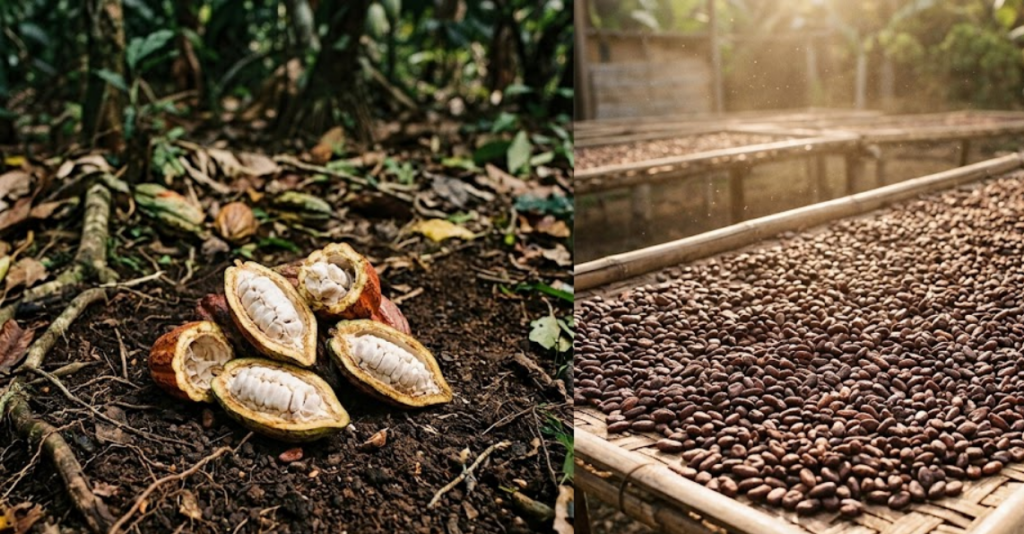
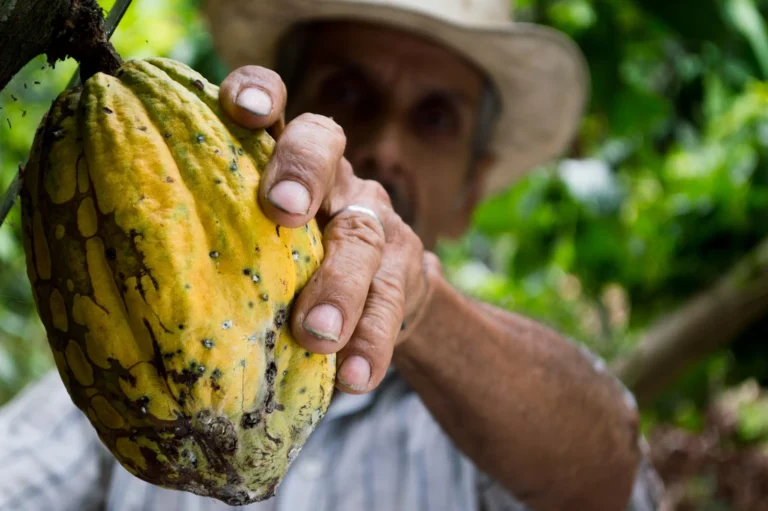
Cadmium gets into a cacao bean while the tree is still growing. The roots pull it up from the soil. Lead gets in afterward, once workers have already picked the beans, while they sit outside drying in the sun. One is a growing problem. The other is a handling problem. Lumping them together into a single “heavy metals” scare misses the one distinction that actually tells you something useful: a farmer can’t do much about one of these, and a producer chose to let the other one happen. (For more on what actually goes into growing cacao responsibly, see our piece on cocoa farming and sustainability.)
The Cadmium Pathway: It’s in the Ground Before the Tree Ever Sees It
This is why cadmium shows up so heavily in cacao from certain regions, particularly parts of Latin America with volcanic soil. It’s naturally occurring geology, not pollution, and not a certification failure. A grower can shift practices at the margins. Early field research into soil amendments like lime or compost shows some promise in reducing uptake. But nobody fixes this problem with better labor standards or an organic certification. The ground the tree grew in decided the cadmium level, years before harvest.
The Lead Pathway: It Happens After the Beans Are Already Picked
Lead tells a completely different story. Research tracing lead through the cacao supply chain found that post-harvest handling causes most lead contamination during the outdoor fermentation and drying of beans, when soil and dust containing lead touch the bean shell. The bean itself isn’t the problem. The shell is. It absorbs airborne lead remarkably well, and once the shell picks up contamination, that lead transfers into the product during processing.
Isotope analysis on cacao from Nigeria backs this up directly. Researchers found a wide spread of lead isotope compositions in finished cocoa and chocolate products. That spread points to contamination happening mostly after the beans left the farm, during shipping, processing, or manufacturing, not from the soil the tree grew in. The same research pointed to one likely source: atmospheric lead from vehicle exhaust in regions still using leaded gasoline, absorbed by beans drying in the open air near roads.
This distinction matters because lead contamination is largely a process choice. A producer can dry beans away from traffic and contamination sources, clean shells thoroughly before processing, and screen incoming beans for lead. That producer is solving a logistics problem, not fighting geology. It’s a controllable variable. And that’s not a coincidence: it’s the difference between a company that responds to a bad test result with a documented sourcing change and one that doesn’t respond at all.
Why This Split Actually Matters to You
Once you separate the two, a few things that looked like contradictions stop being contradictory:
“Organic” doesn’t protect you from either one, but for different reasons. For cadmium, organic certification governs farming inputs like pesticides and synthetic fertilizer, not what’s already sitting in the soil. For lead, organic certification has nothing to say about drying conditions, shell-cleaning, or where beans get processed. A USDA Organic seal was never built to catch either pathway.
Origin matters more for cadmium than for lead. If a brand publishes where its cacao is grown, that’s a real, checkable signal for cadmium risk, because certain regions carry naturally higher soil cadmium. It’s a much weaker signal for lead. Lead contamination depends on what happened to the beans after harvest, and that varies by manufacturer even within the same region.
A brand’s response to bad test results tells you more than the test result itself. Cadmium sits largely outside a producer’s control. Lead doesn’t. So a company that responds to elevated lead levels by changing its post-harvest handling is showing you exactly the kind of control you want to see. A company that stays silent isn’t necessarily hiding something worse. It might just not employ people who pay attention to the parts of the process they could actually fix.
The Actual Numbers, and Why They’re Not a Reason to Panic
This is a good place to be precise instead of alarming, because the regulatory story here is more careful than the headlines suggest.
In 2018, the consumer advocacy group As You Sow settled a long-running Proposition 65 case against the largest chocolate manufacturers in the US, including Hershey, Mars, Nestle, and Lindt. The settlement didn’t ban lead or cadmium in chocolate. Instead, it set specific warning thresholds tied to cacao content. Chocolate with up to 65% cacao triggers a warning above 0.065 parts per million lead and 0.320 parts per million cadmium. The ones between 65-95% cacao triggers one at 0.1 ppm lead and 0.4 ppm cadmium. Chocolate above 95% cacao triggers one at 0.2 ppm lead and 0.8 ppm cadmium. (Full thresholds here.) The settlement also funded a multi-year expert panel to study feasible ways to reduce both metals, since it effectively acknowledged that chocolate naturally contains some lead and cadmium. It’s not purely a manufacturing defect.
The panel released its conclusions in 2022, and they were notably not alarmist. The experts largely agreed producers could hit the lead thresholds through better post-harvest handling. On cadmium, most of the panel concluded that lowering the thresholds further wasn’t currently feasible, precisely because it’s a soil-geology problem rather than a process one.
It’s also worth saying plainly: these thresholds are deliberately conservative. California built them around its Maximum Allowable Dose Level standard, which sets a wide safety margin to protect the most vulnerable populations rather than marking the point where real harm begins. One toxicologist told reporters that eating these chocolates in moderation isn’t something to worry about. Eating a square of dark chocolate occasionally is not a health emergency. The reason to pay attention to any of this is different: “organic” and “premium” branding tells you nothing about where a bar falls on either of these two very different risks, and two brands that get flagged for the same reason might deserve very different levels of concern.
What This Actually Means When You’re Standing in the Chocolate Aisle
You don’t need to memorize soil chemistry to use this. Two practical takeaways:
If a brand publishes independent, recent lab testing for both metals, it’s doing something meaningful, regardless of organic certification. That’s evidence, not a marketing claim.
If a brand fails a test, ask what it did next, not just whether it failed. A published sourcing or process change in response shows a company solving the fixable half of the problem. Silence isn’t automatically damning, but it isn’t reassuring either. It’s the one part of this whole picture a company actually controls.
This same gap between what a seal certifies and what it actually tests for shows up elsewhere in the organic aisle too. Our spirulina roundup runs into a version of the same problem: USDA Organic governs growing inputs, not what the algae absorbs from the water it grows in.
For the specific brands that passed independent Consumer Reports testing on both metals, see our organic dark chocolate roundup.