Our acai powder roundup flagged a real gap. USDA Organic certifies farming inputs, not the finished powder’s heavy metal load. That piece named which brands actually verify their product independently. This one answers the question that leaves open. Why does acai specifically carry more contamination risk than a crop grown on regulated farmland? And how much of that risk is real, versus theoretical?
Why a Wild-Harvested Fruit Behaves Differently Than a Farmed Crop
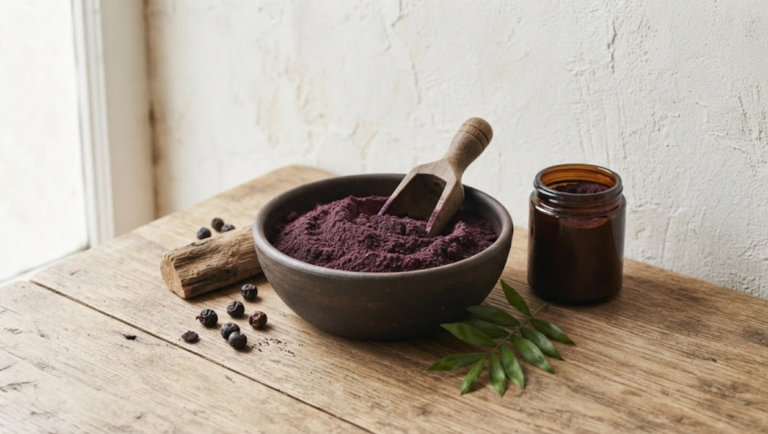
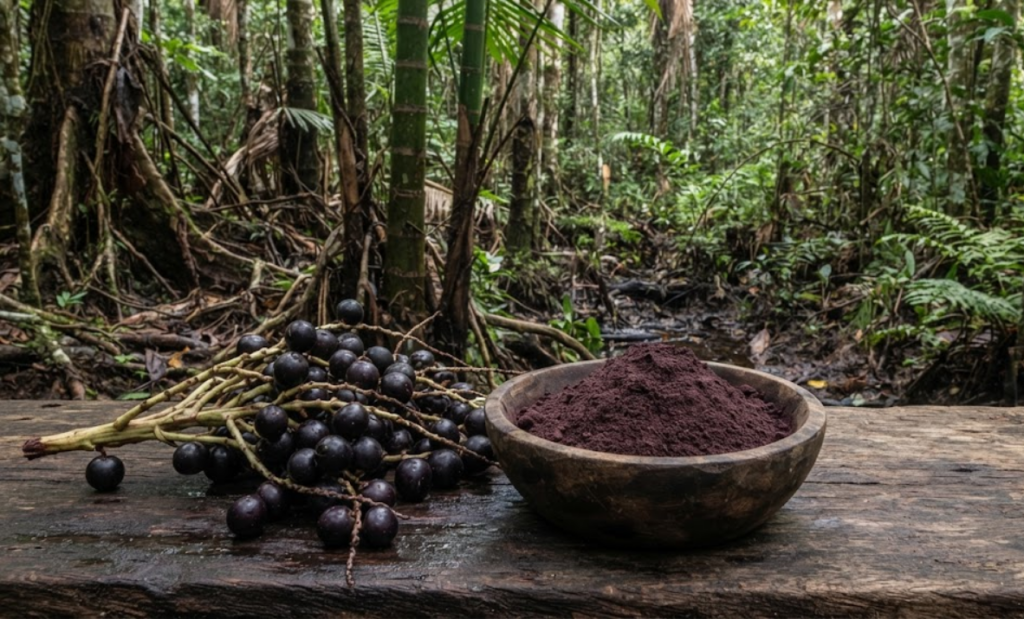
Almonds, cacao, and most other powder-category crops grow on cultivated farmland. A grower there controls the soil, the irrigation source, and the processing facility. Açaí palms mostly don’t work that way. They grow wild or semi-wild across the Amazon basin, much of it floodplain terrain that floods seasonally and carries sediment from upstream. That sediment can concentrate naturally occurring heavy metals. It’s a geological fact with nothing to do with farming method. An organic açaí grove on that soil and a conventional one on the same soil face the same baseline exposure. Organic certification governs inputs like pesticides and fertilizer. It says nothing about what the ground itself already contains.
Processing compounds the variability. Açaí berries are typically pulped and dried close to where they’re harvested. That often happens at small, decentralized operations rather than a handful of large, standardized processing plants. Almond flour and cacao mostly pass through consolidated, industrial-scale facilities instead. Those are easier to audit, and more likely to already be tested by an outside lab. Acai’s supply chain is more fragmented. That fragmentation is part of why the category has drawn so little outside testing attention compared to almonds or cacao.
The One Real Test That Exists, and Its Limits
Peer-reviewed testing of acai for heavy metals is genuinely rare. The clearest example comes from a 2016 study published in the American-Eurasian Journal of Agricultural and Environmental Sciences. Researchers measured lead, chromium, copper, manganese, nickel, and zinc in acai pulp, jam, and jelly produced by RECA, a cooperative in Rondônia, Brazil. The result was reassuring for that specific source. Lead came in at 0.01 micrograms per gram across all products tested, well under Brazil’s regulatory ceiling of 0.05 to 2.00 micrograms per gram. The other metals measured also stayed within acceptable limits.
That’s a genuinely useful data point, and also a narrow one. It covers a single producer in a single Brazilian state, using samples the researchers collected themselves, not a market survey of the commercial brands sold in the United States. That’s a real answer about what’s possible when a specific supply chain gets tested. It’s not an answer to whether the acai powder in a random bag on a US shelf would test the same way, sourced as it is through a different region and a different chain of hands. One clean study from one cooperative isn’t an industry-wide answer. Treating it as one would repeat the same overreach the roundup piece was built to push back against.
A Better-Documented Version of the Same Mechanism
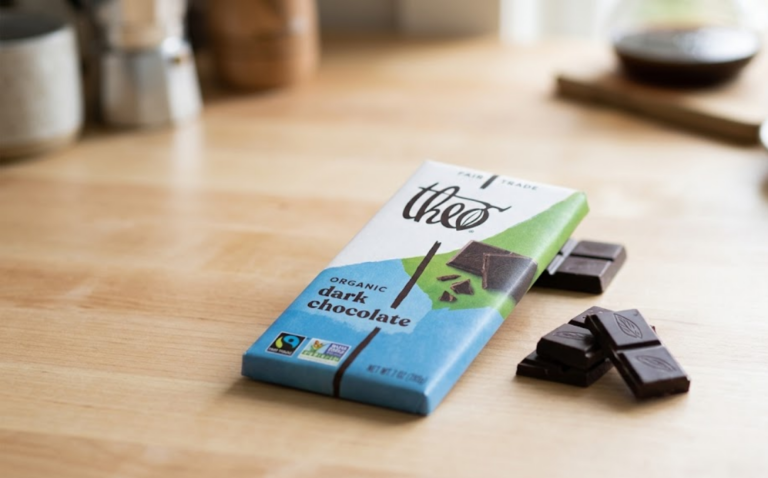
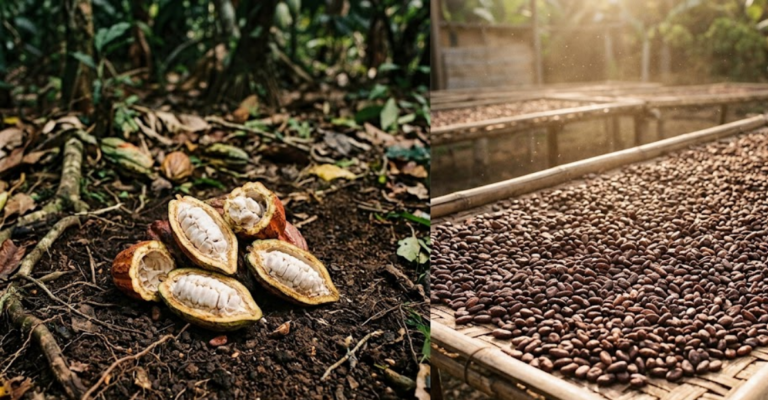
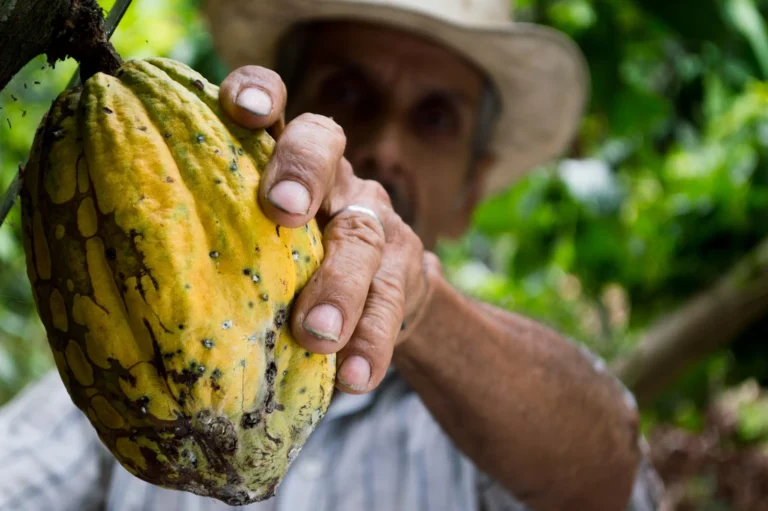
Cacao offers a clearer picture of how this actually plays out at scale. Our dark chocolate roundup covers the buying side of that problem. Cacao grown in parts of Latin America and the Caribbean absorbs cadmium from naturally cadmium-rich volcanic soil. That pattern is documented closely enough that the European Union now regulates cadmium limits in chocolate by product category. The regulation exists because the science is settled: the metal comes from the ground the tree grows in, not from how the farm is run. A certified-organic cacao farm on that same volcanic soil still produces cadmium-contaminated organic beans. Organic rules were never built to screen for what’s already in the dirt.
Açaí’s floodplain soil is a different geology than cacao’s volcanic soil, and the two crops shouldn’t be treated as interchangeable. But the underlying mechanism is the same one: naturally occurring metal in the soil moving into the plant, regardless of certification. That mechanism is far better studied in cacao, because cacao has had a decade of regulatory pressure and independent testing behind it. Acai hasn’t had that pressure yet. That’s a testing gap, not proof of safety, and not proof of danger either.
How Real Independent Testing Actually Works
ConsumerLab’s published methodology is a useful reference point for what a real testing process looks like. Products get analyzed with Inductively Coupled Plasma Mass Spectrometry, a technique sensitive enough to detect metal concentrations far below what a home test kit could catch. ConsumerLab holds cadmium to under 0.3 parts per million, the same threshold the World Health Organization uses. It holds lead to California’s Proposition 65 limit of 0.5 micrograms per daily serving. A product that fails initial testing gets a second look at an independent lab before ConsumerLab publishes a result. A single anomalous reading doesn’t automatically become a public flag.
That’s the bar a brand’s own “third-party tested” claim should be measured against. A real test has a named method, a named threshold, and a named lab behind it. A bag that simply says “tested,” without any of those three details, hasn’t told a buyer much.
What This Actually Means for the Bag on Your Shelf
None of this adds up to a reason to avoid acai powder. It adds up to a reason to stop treating “USDA Organic” as an answer to a question it was never designed to address. Look for the same signal the roundup used: does the brand publish, or offer on request, an actual lab result with a real method and threshold behind it? Terrasoul and KOS both do. Acai as a category simply hasn’t had the years of independent scrutiny that cacao and protein powder have had. That gap is less a reason for alarm than a reason to lean harder on whichever brands are actually willing to be checked.